

Monitoring and evaluation
Alternative labels
Government performance
Monitoring and Evaluation Framework
Evaluation
Discussion paper
Democratic resilience: moving from theoretical frameworks to a practical measurement agenda
This paper examines democracy as a resilient system, emphasising the role of applied analysis in shaping effective policy and programs, particularly in Australia. It proposes a practical agenda centred on three core strengthening flows of democratic resilience: trusted institutions, credible information and social inclusion.
Report
Randomised trials in Australian public policy: a review
Randomised trials are a powerful tool for estimating the ‘causal effects’ of a program or policy. This report takes stock of the published randomised policy trials that have been conducted in Australia, examines the ethics and cultural appropriateness of randomised trials, and discusses future directions for randomised policy trials in Australia.
Report
State of evaluation in the Australian Government 2025
This report reflects a whole-of-government effort to assess how evaluation is currently used to determine what works, for whom, and why. Findings show promising signs of increased evaluation efforts across the Australian Government. However, further work is needed to ensure evaluation practices are consistent, high‑quality and routinely used to inform policy design and delivery.
Report
Review of the operation of Victoria’s Voluntary Assisted Dying Act 2017
This report reviews the first four years of Victoria's Voluntary Assisted Dying Act 2017, finding it is generally operating safely and as intended. The report also identifies areas for improvement, including enhancing community awareness, supporting the workforce and ensuring equitable access, particularly for Aboriginal and Torres Strait Islander and multicultural communities.
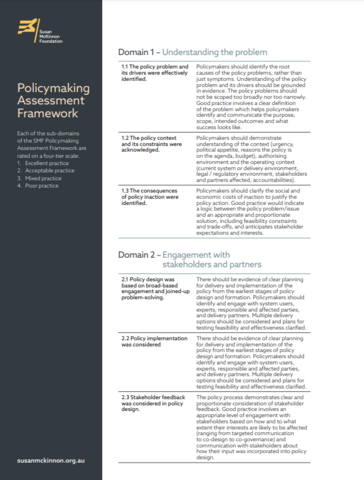
Guide
Policymaking assessment framework
This assessment tool supports the measurement of the quality of policymaking processes – both existing and planned – across sectors. It provides a flexible framework for rating public policy processes using information available in the public domain. The framework's objective is to simplify the path towards best practice, evidence-informed policy.