

Preventative health
Report
The state of multicultural mental health in Australia
This report examines the extent to which mental health policy intent, legal obligations and fundamental principles are being realised in practice. It identifies examples of emerging good practice with the potential to be adopted at scale and contribute to the realisation of policy objectives. It finds overseas-born Australians more likely to delay mental health support.

Report
The economic case for preventing mental ill health
Poor mental health affects more than one in five people across OECD and European Union countries. Focusing on depression and anxiety, this report sets out the strong economic case for investing in better mental health policies. It shows how evidence‑based interventions can improve health outcomes and boost economic growth through improved productivity and labour market...
Survey Report
Parent mental health and wellbeing
This report details findings from the Parenting Today survey, designed to provide a comprehensive national picture of parenting, wellbeing and support needs across Australia. It describes the prevalence and correlates of parent psychological distress. The report argues support for parent mental health must be considered a core component of prevention and early intervention efforts.
Briefing paper
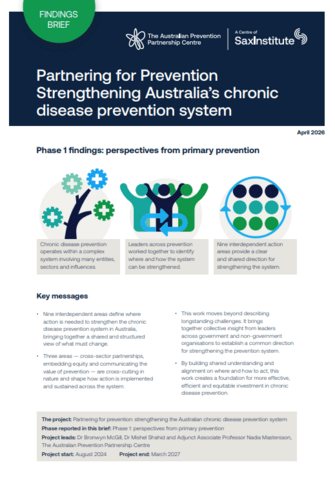
Partnering for prevention: strengthening Australia’s chronic disease prevention system
Strengthening chronic disease prevention requires more than individual programs. It depends on systems that support coordinated, equitable and well-governed action. This brief summarises insights from a Partnering for Prevention initiative, focused on primary prevention. It identifies nine action areas that define the key elements of a stronger chronic disease prevention system in Australia.
Report
Parent, peer and school connections may help reduce suicide risk for young Australians
This snapshot discusses suicidal thoughts and behaviours in adolescence. This research highlights that, among young Australians, positive relationships with parents and peers and school connections during adolescence are associated with the reduced likelihood of suicidal thoughts and behaviours during early adulthood. Collectively, the evidence supports a cross-portfolio, prevention-focused approach to reduce risk.