

Cognitive impairment
Alternative labels
Cognitive disability
Report
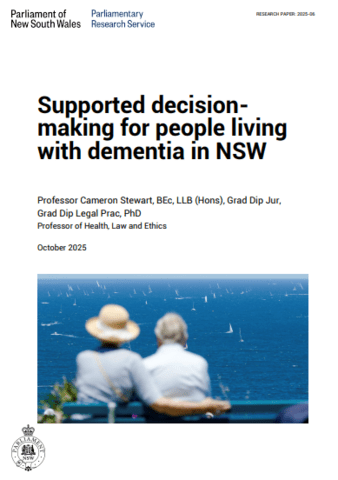
Supported decision-making for people living with dementia in NSW
This paper examines how legal frameworks in New South Wales (NSW) shape decision-making for people living with dementia, given the challenges posed by progressive cognitive decline. It considers traditional surrogate decision-making models and the supported decision-making approach. The paper highlights legal reforms and experiences from other Australian jurisdictions, in particular Victoria.
Report
Global status report on neurology
Neurological conditions affect over 1 in 3 people worldwide. This report on neurology presents the first comprehensive global assessment of the public health response to neurological disorders under the Intersectoral Global Action Plan on epilepsy and other neurological disorders (IGAP). The report offers recommendations for policymakers, IGAP partners and the global neurology community.
Journal article
Co-designing with adults with acquired neurological disability in the community: a scoping review and thematic synthesis
This scoping review examines how and when co‑design is used with adults with acquired neurological disability and their lived experience. It finds co‑design remains under‑researched and underutilised, yet is meaningful, supporting participation, connection, belonging and learning. Future work should better define co‑design and invest in facilitation roles.

Survey Report
Survey on people with disability in community housing
This survey report examines community housing providers' practices, challenges, and capacity‑building needs for housing people with disability. It covers general community tenancies and Specialist Disability Accommodation (SDA) funded by the National Disability Insurance Scheme (NDIS), and presents recommendations identifying priority areas for policy improvement.
Journal article
Rethinking how people with cognitive disability complain
People with cognitive disability express dissatisfaction in varied ways, often missed by support workers. This study shows complaints can be verbal, behavioural or silent, and effective support relies on mutual recognition and broader understandings of “complaining.” Improving awareness and responses is essential, and further research is needed to understand what helps or hinders people and...