

Justice
Report
Voluntary assisted dying in the Northern Territory
The final report from an inquiry into voluntary assisted dying (VAD) in the Northern Territory (NT). VAD is not currently legal in the NT. The report recommends that VAD legislation be adopted. It contains the Committee’s 86 recommendations including drafting instructions. A series of guiding principles are recommended to be reflected in the VAD legislation.
Report
First-time violent offending following psychosis diagnosis: exploring community treatment order use and sociodemographic risk factors
This New South Wales study of people diagnosed with psychosis found that 15% committed a violent offence, most commonly within four years following diagnosis. Community treatment orders are an increasingly implemented violence prevention tool for those with severe mental illness. The findings suggest a heightened need for violence prevention efforts in the first four years...
Report
The great regression: how unions and the Government have changed the rules from accord to central control
The Australian Government has introduced a series of industrial relations (IR) laws that in large part mark a deliberate and systematic shift away from the enterprise-level bargaining model. This report details how the Government’s IR laws are reshaping Australia’s industrial landscape and radically regressing from the workplace reforms of the Hawke and Keating government era.
Briefing paper
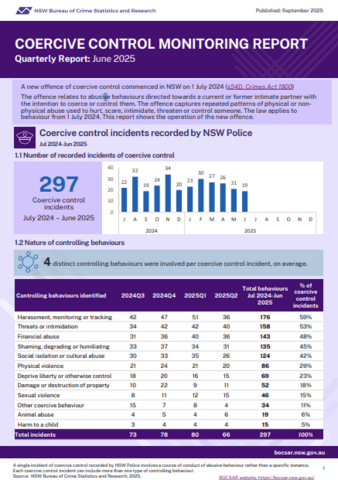
Coercive control monitoring report
Data on the first year of New South Wales (NSW) landmark coercive control legislation, which came into force on 1 July 2024. The legislation criminalises patterns of abusive behaviour in intimate partner relationships, marking a significant shift in how domestic abuse is recognised and addressed.
Report
Victim-survivors' perspectives on post-custodial measures for people with convictions for sexual offending
This paper presents results from an Australian study that investigated the perspectives of victim-survivors about post-custodial measures for people with convictions for sexual offending (PCSOs). It addressed victim-survivors’ reasons for supporting or opposing a wide range of PCSO post-custodial measures. The study emphasises the importance of considering victim-survivor perspectives in shaping post-custodial interventions for PCSOs.