

Social issues
Alternative labels
Social sciences
Social policy
Social problems
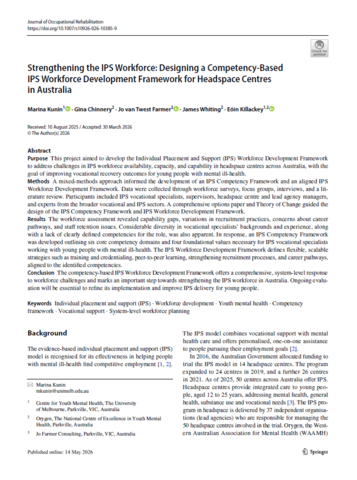
Journal article
Strengthening the IPS workforce
This article describes the development of the Individual Placement and Support (IPS) Workforce Development Framework. The framework aims to address challenges in IPS workforce availability, capacity, and capability in headspace centres across Australia, with the goal of improving vocational recovery outcomes for young people with mental ill-health.
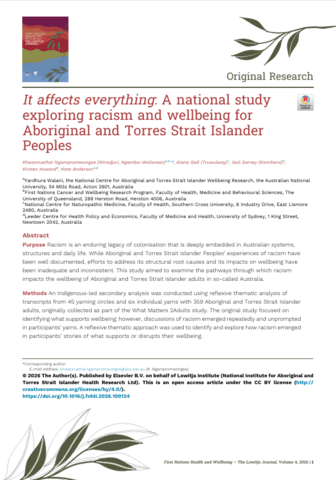
Journal article
It affects everything: a national study exploring racism and wellbeing for Aboriginal and Torres Strait Islander Peoples
This Indigenous-led analysis describes the ways racism disrupts the social and emotional wellbeing of Aboriginal and Torres Strait Islander Peoples. The study underscores the need to move beyond individualised health models toward decolonial systems of care grounded in self-determination, truth-telling and structural change.

Briefing paper
Take a seat: listening to the policy priorities of Australia's young women
Young women are persistently absent from policymaking, but are overrepresented in experiences of financial stress, gender-based violence, medical misogyny and climate anxiety. This policy brief, written by young women, presents the most pressing policy issues impacting young Australians, and calls on the Australian Government to resource their expertise and safeguard their futures.
Report
Effectiveness of the Commonwealth Home Support Program
The Commonwealth Home Support Program (CHSP) has provided entry‑level aged care services to people in their homes to assist them to live safely and independently. This audit examined the effectiveness of the CHSP. The audit found the CHSP is partly effective. It provides recommendations to improve planning, monitoring, stakeholder engagement, assurance, performance measurement and evaluation.
Report
First Nations & intellectual disability inclusive research report
This report provides insights into conducting research around intellectual disability with First Nations people in ways that are culturally safe and appropriate. It highlights the difference between First Nations and white and Western approaches to intellectual disability, and the need to have First Nations people and communities involved as researchers and stakeholders at every point.