

Economics
Alternative labels
Economy
Economic management
Macroeconomics
Economic policy
Discussion paper
Discount or penalty? How high inflation turns the capital gains discount into a hidden tax on investment
The role of inflation in determining the merits of different forms of capital gains taxation is widely misunderstood. This paper finds the discount is not always more generous than the previous system and can produce very high effective rates of taxation on real capital gains because taxation is levied on both real and inflationary gains.
Briefing paper
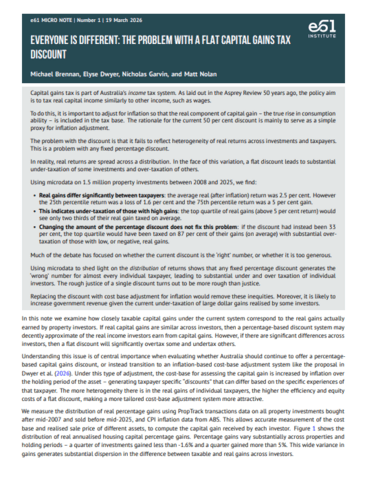
Everyone is different: the problem with a flat capital gains tax discount
One objective of Australia’s capital gains tax (CGT) discount is to approximate inflation and tax real gains. But because real returns vary widely across investors, a flat discount systematically misses the mark. Using data on 1.5 million property investments (2008–2025), this paper shows real returns range from losses to strong gains.

Report
Generation trapped: housing, handouts, and the collapse of young Australians’ life satisfaction
Life satisfaction is trending down for young people in Australia and the West. This paper examines the lives, aspirations, values and perceived barriers of Australians aged 18–34. It creates a foundation for evaluating existing policy and developing new policy to support the priorities and goals of these young Australians.
Report
A fair retirement: removing barriers in super for First Nations peoples
The super system in Australia was not designed with the unique experiences and needs of many First Nations people. This report shares examples of good practices by super funds to meet the needs of Aboriginal and Torres Strait Islander people and makes recommendations for further improvements to deliver a fairer experience for First Nations members.
Video
Lunch & learn: systematic instruction
This recorded webinar examines the concept of systematic instruction and its application to the training of people with intellectual disability to perform tasks, including those likely to be needed in workplace settings. It shares practical evidence- based insights to support people with intellectual disability to increase their practical learning and work skills.