

Economics
Alternative labels
Economy
Economic management
Macroeconomics
Economic policy
Guide
Neurodiversity data at work
This guide outlines how to measure and report workforce neurodiversity in a respectful, safe and accurate way. It explains how collecting neurodiversity data can strengthen workplace neuroinclusion and presents six guiding principles to support effective, ethical and trustworthy data collection practices.
Report
Organizational transformation in the age of AI: how organizations maximize AI’s potential
This white paper examines how leading organisations are embedding artificial intelligence (AI) across customer experience, operations, R&D, strategic planning and talent. Drawing on insights from more than 450 executives worldwide, it highlights a shift from isolated use cases to connected systems, from episodic initiatives to continuous processes and from task automation to human value creation.
Fact sheet
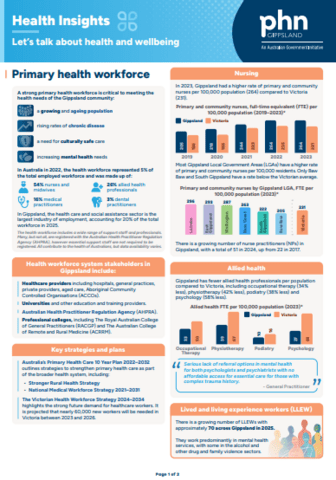
Health insights: primary health workforce
This fact sheet provides insights and statistical data on the primary health workforce in Gippsland, Victoria. It provides an overview of nursing, allied health and medical health practitioners in comparison to Victoria. In Gippsland, the health care and social assistance sector is the largest industry of employment, accounting for 20% of the total workforce in...
Briefing paper
The unfair distribution of the CGT discount by electorate
The briefing paper provides an analysis of all 150 federal electorates in Australia to show the flow of the 50% Capital Gains Tax (CGT) discount. It finds that the benefits of the CGT discount flow overwhelmingly to a small number of high-income, inner-city electorates in the eastern states.
Report
Fossil fuel subsidies in Australia 2026
A report on Australian state and federal government assistance to producers and major users of fossil fuels in 2025–26. It finds growth in fossil fuel subsidies is driven by the federal government’s Fuel Tax Credit Scheme. The growth of this scheme is expected to outstrip spending on a range of social services.