

Economics
Alternative labels
Economy
Economic management
Macroeconomics
Economic policy
Briefing paper
The cost-of-living crisis and youth mental health
Australia’s cost of living crisis continues to be a significant issue. It is not just of economic concern, it is a major social determinant of health, having profound negative impacts on the protective factors for mental health and wellbeing. Young Australians are particularly vulnerable. This policy brief outlines four policy recommendations to address the crisis.
Briefing paper
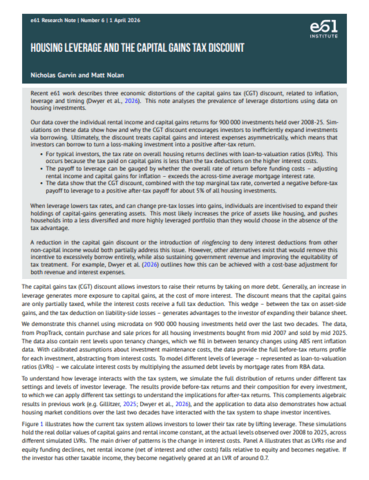
Housing leverage and the capital gains tax discount
This note on the capital gains tax (CGT) discount focuses on leverage distortions by investigating data on housing investments. By examining the individual rental income and capital gains returns for 900,000 housing investments held over 2008 to 2025, the note demonstrates how and why the CGT discount encourages investors to borrow more than they otherwise...
Report
Safeguard Mechanism emissions sensitivities and baseline impacts
Australia's Safeguard Mechanism – designed to cut industrial climate pollution – is up for review in 2026–27. This new modelling shows the scheme is on track to fall well short of Australia’s 2035 climate target unless urgent reforms are made. The report finds that the scheme is being gamed by coal and gas corporations.
Report
Mandatory spending in budgeting in selected OECD countries
Large portions of spending by national governments can be considered mandatory. Drawing on practices from eight OECD countries, this paper examines how governments define, monitor and review mandatory spending. The analysis suggests that mandatory spending should be reviewed regularly, included in fiscal rules and budget processes, and be subject to clear accountabilities to parliament.
Report
Standards enabling Australia’s sustainable transition
Australia’s sustainability transition is being reshaped by global uncertainty, heightened climate impacts and rapid economic transformation. In this environment, the challenge is not only setting ambition, but creating the conditions that enable confidence, consistency and momentum. This paper examines how standards are supporting this shift from policy intent to real‑world outcomes.